
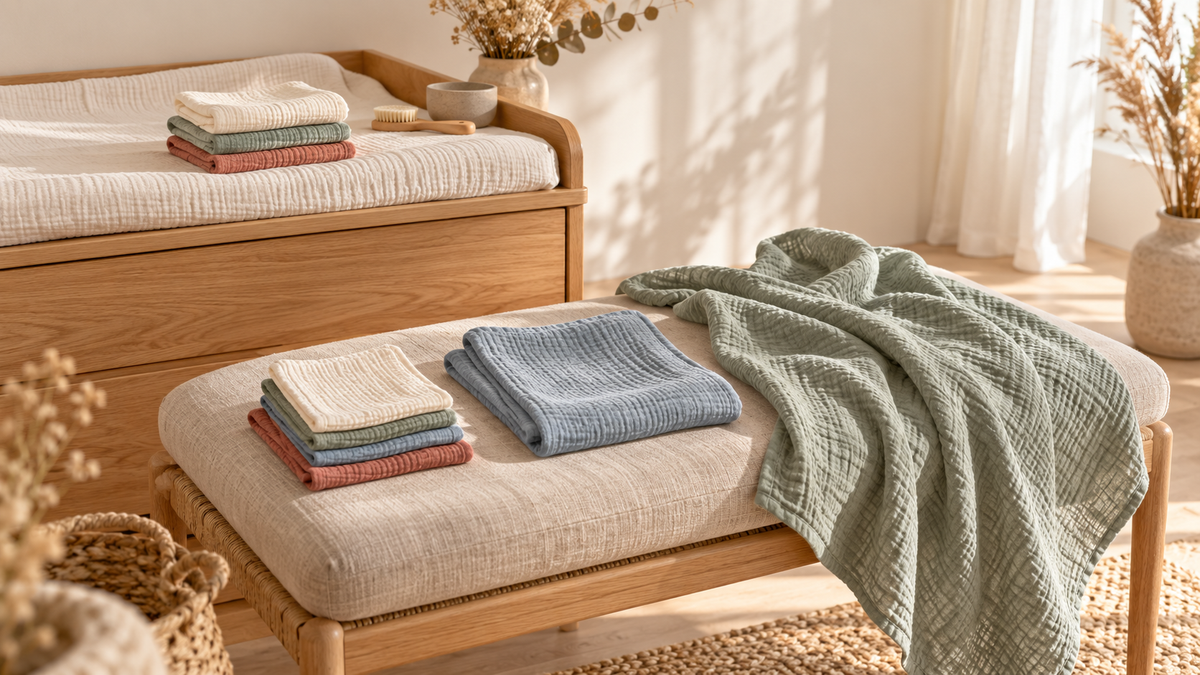
Muslin cloth sizes compared: Which size for what?
The right muslin cloth size depends primarily on what you want to use the cloth for: 70 × 70 cm is handy for a burp cloth, your shoulder, and the diaper bag; 80 × 80 cm offers a bit more surface area for versatile everyday use; and 115 to 120 × 120 cm is suitable for large-scale tasks like a light changing mat or for drying off. For many families, a combination of several small cloths and one or two XL cloths is the most practical choice.
Muslin cloth sizes at a quick glance
| Size | Especially practical for | Things to consider |
|---|---|---|
| 70 × 70 cm | Burp cloth, shoulder, small changing mat, diaper bag | Compact, but quickly too small for large-scale tasks |
| 80 × 80 cm | Versatile everyday cloth, larger mat, light drying | Good middle ground, but not as compact as 70 × 70 cm |
| 115–120 × 120 cm | Large mat, drying, supervised play and cuddle time | Requires more storage space and is often unnecessarily large for small mishaps |
Muslin cloth, swaddle, or burp cloth: What is the difference?
In everyday family life, muslin cloth and burp cloth are often used as similar or interchangeable terms. They usually refer to a light, loosely woven textile with a soft, slightly crinkled surface. In retail, "swaddle" often refers to a larger cloth – but on its own, it signifies neither a fixed size nor a specific safe application.
Therefore, look at the dimensions first and then at the material, care instructions, and manufacturer details. A cloth sold as a "swaddle" can be 120 × 120 cm, for example; however, the word alone is not a recommendation for putting a baby to sleep or swaddling them.
Which muslin cloth size fits which purpose?
70 × 70 cm: compact and easy to change
The small size fits well in the diaper bag and is quickly at hand when something goes wrong during a burping session. It protects your clothing on your shoulder, and while on the go, it can serve as an additional clean layer on a changing mat. Because small cloths take up little space, several of them can be taken along and replaced individually if needed.
For parents primarily looking for a classic burp and everyday cloth, 70 × 70 cm is usually the most targeted choice. However, the surface area is often insufficient for full-body drying or as a larger floor mat.
80 × 80 cm: the versatile middle ground
An 80 × 80 cm cloth offers noticeably more surface area while remaining easy to fold. It can serve as a generous burp cloth, a light mat, or for drying small body areas. This size is interesting if you don't want to buy a different format for every task.
Whether 70 or 80 cm is a better fit is less a question of age than a question of your habits: those who pack as compactly as possible tend to choose 70 cm. Those who like to fold a cloth multiple times or prefer more surface area lean towards 80 cm.
115 to 120 × 120 cm: plenty of surface for flexible use
XL muslin cloths are large enough to be used as a light mat for changing or supervised play. Even after bathing, they offer plenty of surface area for gentle patting dry. When folded, they can serve as a clean mat; opened fully, they cover a significantly larger area.
The size makes XL cloths flexible, but not automatically better for every use. They are often more cumbersome for the shoulder, take up more space in a small diaper bag, and after a small mishap, an unnecessary amount of fabric ends up in the laundry.
How many muslin cloths do you need?
There is no rigid number. The determining factors are how often the baby spits up, your laundry cycle, and the planned uses. A reasonable start often involves a small set of handy everyday cloths plus one or two large cloths. After the first few weeks, it is easier to judge which size you actually use often.
Do not plan only by "per day," but by your laundry rhythm: one cloth may need to go into the wash immediately after a small spot, while another stays clean longer. In our baby essentials checklist, you will find further tips on how to put together textile basics sensibly and without unnecessary duplicate purchases.
Material and care: What you should pay attention to
Cotton is common; some cloths are made of organic cotton or a blend with viscose from bamboo fiber. However, the material alone does not determine everyday suitability. Also check the seams, feel, dimensions, and care label. Especially with frequently used cloths, it is important that the wash permitted by the manufacturer fits your daily routine.
Washing temperatures vary by product. The models shown in this guide, for example, do not all have the same care recommendations. Therefore, always follow the label on the specific cloth. Wash new baby textiles before first use and check them regularly for open seams or damage.
Use safely: Muslin cloths should not be left loose in the baby bed
This recommendation is supported by official specialist agencies for safe baby sleep. The Federal Center for Health Education, the Bavarian State Office for Health and Food Safety, and the NRW Ministry of Health advise a clear, minimally equipped sleeping environment and a well-fitting sleeping bag.
Also, make sure outside of the crib that a cloth never covers the face or airways. Do not stretch it as a tightly closing sun protection over a stroller or infant carrier. This size comparison is also not a swaddling tutorial: if you would like to swaddle your baby, get an individual guide from a midwife or pediatrician and follow current recommendations for safe sleep.
Suitable muslin cloths for various tasks
The following models were available in at least one variant during our inspection. The selection covers compact formats, a middle ground, and XL cloths.


Typical mistakes when choosing
- Deciding only based on product name: Measure the size in your mind or place an existing cloth next to it. "Swaddle" and "muslin cloth" do not reliably reveal the dimensions.
- Buying only one format: Small and large fulfill different tasks. A mixed set prevents an XL cloth from having to go into the laundry for every little mishap.
- Generalizing care instructions: Washing temperature and dryer suitability depend on the product. The label takes priority.
- Confusing a light cloth with safe sleep gear: Even thin, breathable-looking fabrics remain loose textiles and do not belong in the baby bed.
Conclusion: The best size is a question of the task
For spitting up, shoulders, and on the go, 70 × 70 cm is particularly handy. 80 × 80 cm is a balanced all-rounder, while 115 to 120 × 120 cm scores points where a large surface area is needed. Instead of buying as many cloths of the same size as possible, a small, consciously mixed selection is often more sensible. This keeps the diaper bag light while having a large cloth within reach at home.
If you are planning a trip, our packing list for vacation with a baby helps you plan textile basics appropriate for the length of your trip.
Common questions about muslin cloth sizes
Which muslin cloth size is the most versatile?
80 × 80 cm is a good middle ground because the cloth is still compact while offering more surface area than 70 × 70 cm. Those who already own small burp cloths usually benefit more from an additional XL cloth.
Is 70 × 70 cm large enough?
For shoulder, spitting up, diaper bag, and a small additional mat, 70 × 70 cm is often quite sufficient. For full-body drying or as a large play mat, a format from about 115 × 115 cm is more practical.
What do you need a 120 × 120 cm muslin cloth for?
The XL format is particularly suitable as a large mat, for patting dry after bathing, or for supervised play and cuddle moments. For small everyday spills, it is usually larger than necessary.
Are a swaddle and a muslin cloth the same thing?
In retail, the terms overlap. "Swaddle" is often used for large muslin cloths but is not a binding size specification. Therefore, always compare the centimeter dimensions and the specific usage and care instructions.
Is a baby allowed to sleep with a muslin cloth?
Loose cloths and blankets do not belong in a baby's sleeping environment. Official agencies recommend a clear sleeping environment and a well-fitting baby sleeping bag. A muslin cloth does not replace this.
How many muslin cloths belong in the diaper bag?
That depends on the duration of the trip and needs. Several small cloths are practical so that a soiled one can be stored separately and a clean one can be used. For longer trips, a folded XL cloth can be added as a mat if needed.
Must muslin be washed before first use?
Yes, wash new baby textiles before first use according to the care label. This removes potential residue from manufacturing and storage and allows you to see how the fabric behaves after washing.
