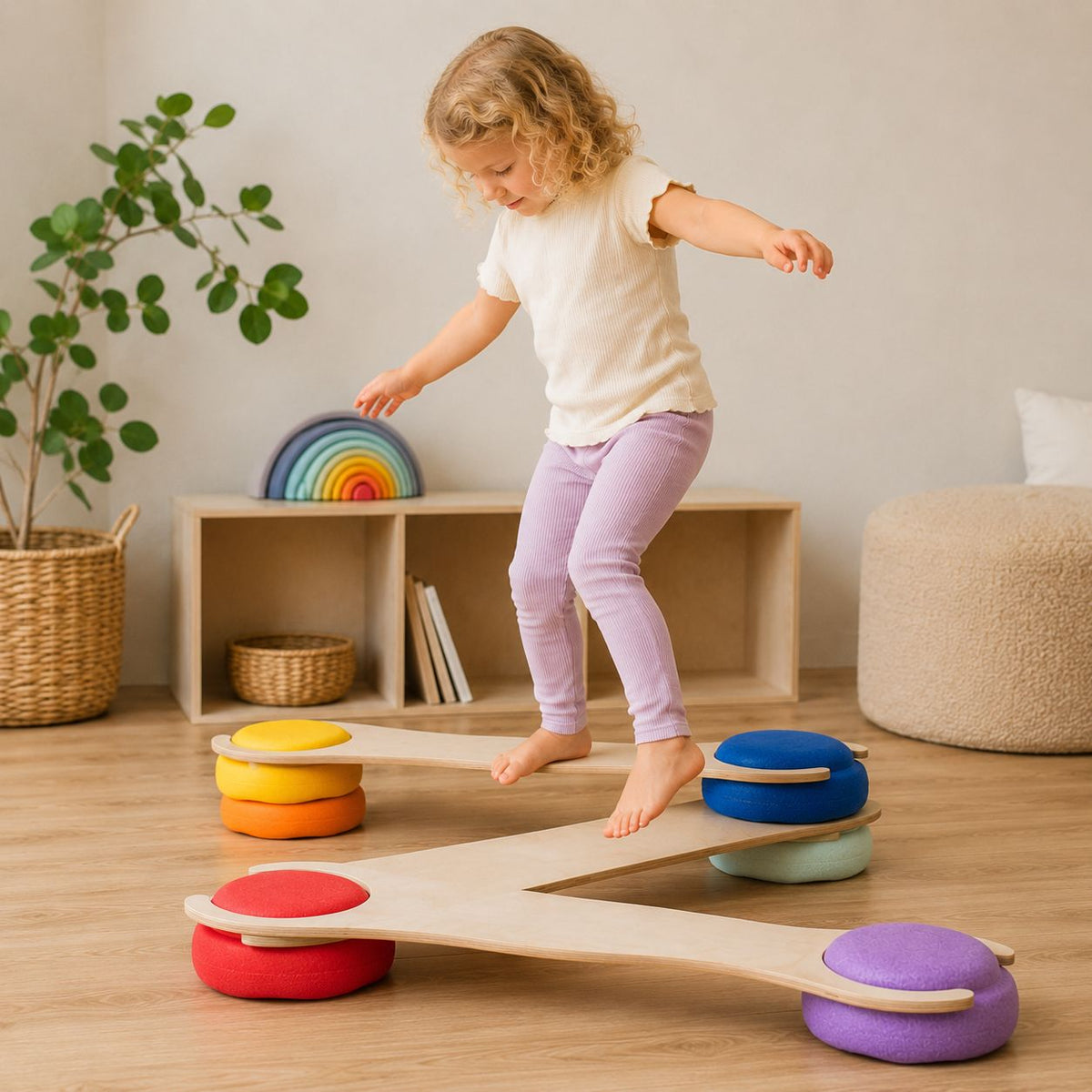
How can you encourage movement in children at home? The best way is through many short, playful movement opportunities throughout the day: balancing, hopping, crawling, throwing, dancing, or building a small obstacle course. This doesn't require a large children's room or expensive equipment – open space, safe everyday objects, and varied play ideas are often enough.
The short answer: Children move more often if movement is easily accessible, fun, and not experienced as a chore. Therefore, don't plan a perfect "sports lesson," but create several opportunities daily for free play and participation. Balance boards and stacking stones can expand possibilities but are not a prerequisite for an active daily life.
Since 2011, Schmatzepuffer has been involved in meaningful play and movement ideas for children. This guide combines our experience from family and product daily life with concrete ideas that can be implemented indoors.
Discover the world of movement for children
Why movement is important for child development
Movement is part of a child's healthy development. When running, climbing, balancing, and throwing, they gain experience with their own body and its surroundings. Different forms of movement can address several areas in an age-appropriate way:
- Gross motor skills: large movements like running, jumping, crawling, and climbing
- Balance and coordination: planning, stabilizing, and coordinating movements
- Body awareness: estimating strength, tempo, distance, and one's own position in space
- Self-efficacy: trying and mastering a self-chosen challenge
- Social learning: taking turns, agreeing on rules, and playing together
It is important to honestly assess: a single toy does not make a child more motorically skilled or more concentrated. Regular movement, varied experiences, joy in play, and safe supervision are crucial.
How much movement do children need per day?
The need for movement depends on age and individual development. The World Health Organization recommends for children aged one to two years at least 180 minutes of different physical activity spread throughout the day. For three to four-year-olds, at least 180 minutes also apply, of which at least 60 minutes should be of moderate to higher intensity. Children and adolescents aged five and older should be moderately to intensely active for an average of at least 60 minutes per day.
| Age | Guidance | Suitable Examples |
|---|---|---|
| Under 1 year | Several times a day active play on the floor; for non-mobile babies, also tummy time when awake | Grasping, turning, scooting, crawling |
| 1–2 years | At least 180 minutes of varied activity spread throughout the day | Walking, pushing, dancing, throwing, small obstacles |
| 3–4 years | At least 180 minutes; of which at least 60 minutes of moderate to higher intensity | Catching, hopping, balancing, climbing, balance bike |
| 5 years and up | On average, at least 60 minutes of moderate to intensive activity daily | Tag games, cycling, swimming, sports, active commuting |
The minutes are a health guideline and do not need to be achieved all at once. Even short active phases count. Sources: WHO guidelines for children under five years of age and WHO overview of physical activity .
Seven easy movement ideas for children at home
1. Build a living room obstacle course
Use cushions, a folded blanket, tape lines, and sturdy play elements to create a path. The child can step over, crawl under, or follow a line. Start simply and only change one element when the path is safely completed.
2. Imitate animal movements
How does a frog hop? How does a cat sneak? How does a bear walk on hands and feet? Animal movements combine fantasy with different movement sequences and work even in a small space.
3. Island game with cushions or stacking stones
Distribute safe "islands" on the floor. The child moves from island to island without touching the floor in between. Variations arise from larger distances, different paths, or color tasks.
4. Balancing line on the floor
A line made of painter's tape is enough: walk forwards, sideways, or transport a small object. This is particularly practical when space is limited.
5. Tidying up as a movement game
Collecting building blocks by color, carrying stuffed animals to their place, or throwing laundry into a basket: daily tasks become active movement breaks through small game rules.
6. Music on, movement free
In musical statues, active phases and short rest impulses alternate. Children can dance fast, slow, big, or small. Adults should participate quietly – role models usually work better than demands.
7. Set up a balance and stacking station
A balance board, stacking stones, or combinable boards enable changing paths, bridges, and balancing tracks. The setup should match the child's ability and not be as difficult as possible.
Practical tip: Ten active minutes before dinner are often easier to maintain than a rare, long movement session. Prepare only a few materials and change the task regularly.
What is a balance board for children?
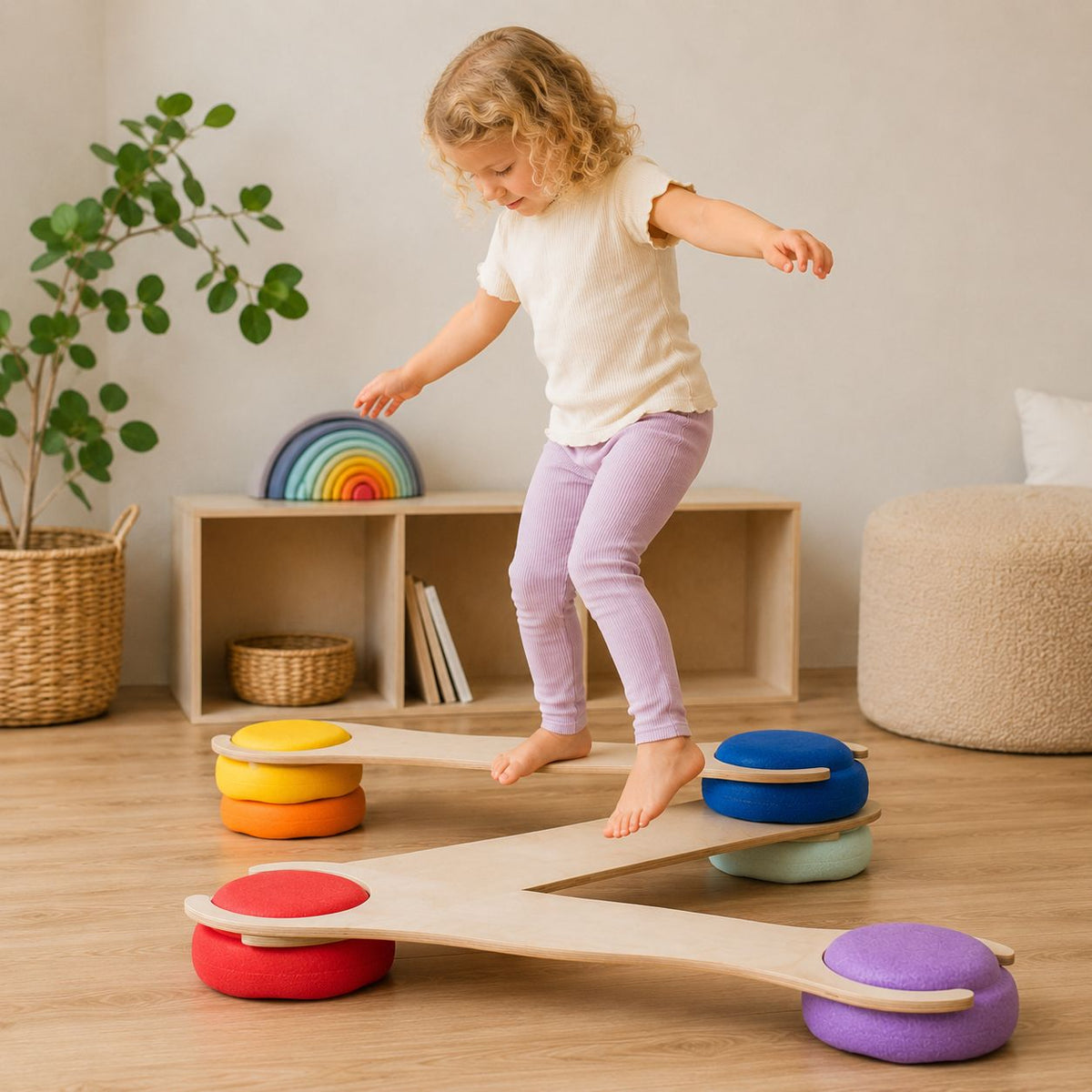
A balance board is a movement element on which children can stand, walk, or – depending on the design – rock. Longer boards with cutouts can also be combined with suitable stacking stones to form bridges and obstacle courses. While playing, the child must continuously adjust their posture to the surface. This playfully addresses balance, coordination, and body awareness.
The versatile use is the real advantage: A board does not dictate a fixed play sequence. Today it is a bridge, tomorrow a path in an obstacle course. Whether it remains permanently interesting still depends on the child, the available space, and how regularly new play impulses arise.
tiSsi Balance Board Set with three boards
The set contains three differently shaped boards and is designed for building variable balancing paths. According to the product description, the boards are each 110 centimeters long, can support up to about 60 kilograms, and can be combined with common stacking stones.

Personalized Balance Board: sensible or primarily a gift idea?
Personalization does not change the motor function of the board. However, it makes the set more individual and can therefore be particularly interesting as a gift for a birthday, Christmas, or moving into a child's room. Crucial factors remain safe processing, suitable dimensions, load capacity, and age-appropriate use.
- individually designed with the child's name
- personal gift idea for active children
- same versatile play possibilities as with the non-personalized set

Single Balance Board or Set: Which suits you?
| Variant | Particularly suitable when… | Points to consider |
|---|---|---|
| Single board | space is limited or you want to first test if the child enjoys balancing | fewer combination possibilities |
| 3-piece set | regularly new routes and larger obstacle courses are to be created | more space needed for use and storage |
| Personalized | the movement toy is intended as an individual gift | personalization increases emotional, not automatically motor, benefit |
| Board plus stacking stones | heights, bridges, and islands are to be flexibly combined | Check compatibility, stability, and manufacturer's instructions |

Combining stacking stones and balance boards
Stacking stones complement suitable boards because they allow for changes in height, distance, and the course of a path. Children can arrange islands, build a bridge, or incorporate colors into a movement task. However, not every board automatically fits every stacking stone. Therefore, before purchasing, check the dimensions and the manufacturer's explicit compatibility statement or the product page.
Safe movement area at home: What parents should pay attention to
- Observe manufacturer's specifications regarding age, assembly, load capacity, and use.
- Before playing, check boards and stacking stones for damage, splinters, cracks, or loose parts.
- Set up on a flat, non-slip surface and keep distance from stairs, windows, radiators, and sharp edges.
- Keep the fall height low and only gradually increase the difficulty.
- Actively supervise children – especially younger ones – and do not push them into an exercise.
- Do not use improvised elevated structures that can tip over or slide away.
Note: This article provides general play and movement ideas and does not replace medical or physical therapy advice. In case of pain, unusual movement patterns, developmental questions, or health limitations, professional advice should be sought.
Frequently Asked Questions about Promoting Movement in Children
How do I encourage my child's movement in a small apartment?
Use short games in a limited space: a tape line for balancing, animal movements, freeze dance, cushion islands, or target throwing with soft balls. A clear, safe floor area is more important than having a dedicated play room.
What movement games are suitable for bad weather?
Living room obstacle courses, freeze dance, scavenger hunts with movement tasks, animal walks, balloon games, and balancing paths are well suited. Adjust the pace and difficulty to the child's age, space, and skill level.
From what age is a balance board suitable for children?
There is no general answer to this. The age and safety instructions of the specific manufacturer and the child's motor development are decisive. A child should be able to safely master the intended movement; younger children require immediate supervision.
What does balancing address?
When balancing, the child continuously adjusts their body posture. This primarily challenges balance, coordination, body tension, and body awareness. The effect depends on regularity, difficulty, and individual development.
Does my child need special movement toys?
No. Movement can also be encouraged with everyday objects, music, and a clear floor space. Special movement elements can create additional variations and be usable for longer if they suit the child, the available space, and the family's daily routine.
How do I motivate a child who doesn't feel like moving?
Offer a choice instead of a chore, participate yourself, and connect to their interests – such as animals, music, or a treasure hunt. Start with short, achievable tasks. Persistent pain, quick exhaustion, or noticeable movement problems should be professionally assessed.
Are balance boards compatible with all stacking stones?
No, not automatically. Shape, recess, and dimensions can vary. Only use combinations that are explicitly stated as compatible on the respective product page or by the manufacturer.
Conclusion: Promoting Movement in Everyday Life – Regularly Rather Than Perfectly
Promoting movement at home doesn't start with a large obstacle course, but with reliable opportunities: dancing together, balancing pathways, running outside, or jumping between cushion islands. The more varied and voluntary the play, the more easily movement becomes part of everyday life.
Balance boards and stacking stones can expand the play area. They are particularly useful if they are age-appropriately selected, safely used, and constantly recombined. Ultimately, the best movement toy is not the one with the most promises, but the one a child enjoys using regularly.