



















For many families, the christening is one of the most important events in a child's first year of life. At the same time, many questions often arise: When should the christening take place? Who can be a godparent? How does a christening ceremony work? What do you give as a christening gift? And how much money is actually an appropriate christening gift?
That is exactly why we have collected and answered in detail the 100 most important questions about christening. This guide is aimed at parents, grandparents, godparents, relatives, and friends who are planning a christening or are invited and want to prepare well.
The answers are based on common questions that families have before the christening. In doing so, we consider both traditional and modern christening celebrations and provide practical tips for planning, organization, gifts, and the course of the big day.
Planning the Christening
1. When Should You Plan a Christening?
Many families begin planning about three to six months before the desired date. Particularly popular dates in spring and summer are often booked early by many church congregations. Anyone who prefers a specific date or church should contact them as early as possible.
In principle, there is no fixed time for a christening. Some parents choose the first months of their child's life, while others wait until the first birthday or even longer. The most important thing is that the family has enough time to prepare.
2. When Are Babies Usually Christened?
Traditionally, christening often takes place within the first year of life. Many families choose a time between the third and twelfth month. Today, however, there is significantly more flexibility than in the past.
Some parents want to enjoy the first exciting time with their baby first and only plan the christening later. Others combine the christening with a special family celebration or a time when relatives can more easily travel.
3. Does a Child Have to Be Christened as a Baby?
No. In principle, a christening is possible at any age. Many people are even christened as teenagers or adults. The decision lies with the parents or, later, with the child themselves.
Christening as a baby has a long tradition above all. It symbolizes the child's admission into the Christian community and is therefore deliberately carried out early by many families.
4. How Early Should You Contact the Church?
Ideally, three to six months before the desired date. In popular congregations or for special desired dates, a longer lead time may also make sense.
During the initial contact, the church usually informs you about available dates, necessary documents, and the requirements for the christening. Often, a personal meeting with the pastor is also arranged.
5. What Documents Are Required for a Christening?
The exact requirements vary depending on the congregation. Often, the child's birth certificate, the parents' details, and information about the godparents are required.
If the godparents come from a different church congregation, a certificate of their church membership is often additionally required. The responsible congregation will inform you about all necessary documents.
6. Can You Have Your Child Christened Outside Your Place of Residence?
Yes. Many families choose the church of their hometown, their favorite place, or a congregation with special family significance.
In this case, the christening congregation often requires approval from the congregation of the place of residence. However, this is usually straightforward and is organized by the churches.
7. Are There Certain Months That Are Particularly Popular for Christenings?
Yes. Dates between April and September are particularly in demand. Many families take advantage of the beautiful weather for a subsequent celebration in the garden, restaurant, or community center.
The Easter season and the summer months also traditionally count among the most popular times for christenings.
8. Can a Christening Take Place Together with Other Children?
Yes. In many congregations, so-called group or group christenings take place. Several children are christened during one church service.
Some families appreciate the solemn community, while others prefer an individual christening in a smaller setting. Both are usually possible.
9. How Long Does It Take to Plan a Christening?
A simple christening can often be organized within a few weeks. However, for larger celebrations with many guests, restaurant reservations, or special program items, several months of lead time are recommended.
The earlier the most important decisions are made, the more relaxed the preparation will be.
10. How Much Does a Christening Cost?
The christening itself is free of charge in most church congregations. Costs usually arise from the subsequent celebration, invitations, clothing, decoration, photographers, or catering for the guests.
Depending on the scale of the celebration, expenses can range from a few hundred euros to several thousand euros. Many families therefore plan a budget early on.
Are You Still Looking for the Right Christening Gift?
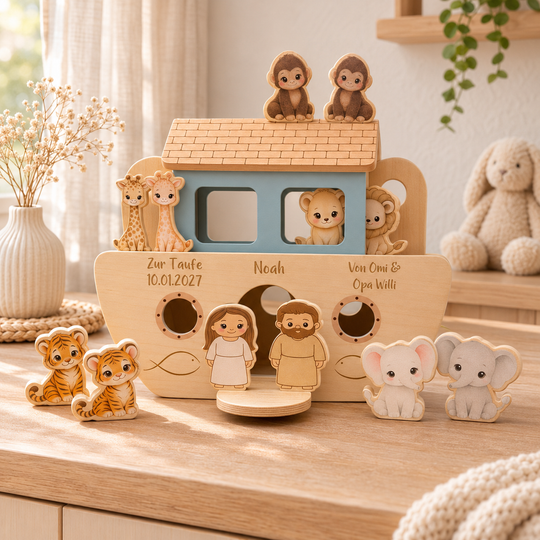
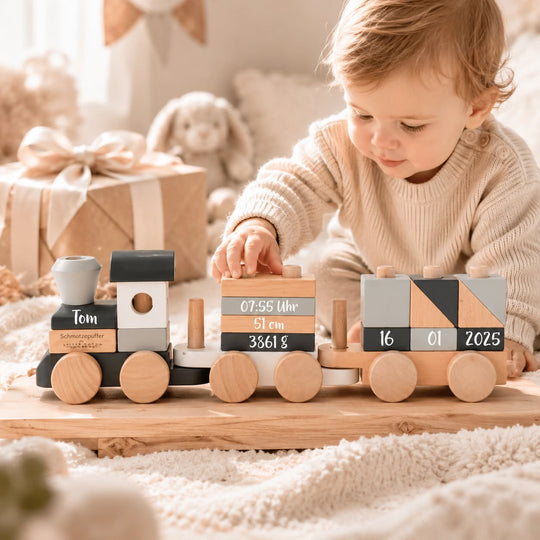
Whether it's a personalized wooden train, Noah's Ark with a name and christening date, a memory box, or a lovingly designed christening gift – discover our most popular gift ideas for christenings. All personalizations are crafted with great care directly at Schmatzepuffer.
Discover Personalized Christening Gifts NowIndividually personalized • High-quality craftsmanship • Lovingly crafted
Next are the questions about godparents, requirements, and the most important decisions before the christening.
11. Who Can Be a Godparent?
The requirements for becoming a godparent vary depending on the denomination and church congregation. In most Protestant and Catholic congregations, godparents must belong to a Christian church and be baptized themselves.
Godparents accompany the child on their life journey and take on a special role within the family. That is why many parents choose people with whom they already have a close personal bond.
12. How Many Godparents Can a Child Have?
In many congregations, at least one godparent is required. Two or more godparents are often also possible. The exact number depends on the regulations of the respective church.
Many families deliberately choose two godparents so that the child will later be accompanied by several important reference persons.
13. Do Godparents Have to Be Church Members?
In most cases, yes. Churches usually expect official godparents to be members of a Christian church themselves and to have received baptism.
Some congregations also allow so-called christening witnesses. They can take on a similar role without being officially registered as a godparent.
14. Can Grandparents Be Godparents?
In principle, there is nothing against it, provided the church requirements are met. However, many families deliberately choose people from a younger generation.
The idea behind this is that godparents can accompany the child for as long as possible. Ultimately, however, the decision remains individual.
15. Can Siblings Be Godparents?
Yes. Adult siblings are often chosen as godparents if they meet the church requirements and have a close relationship with the child.
Especially in small families, this often creates a particularly personal and long-lasting connection.
16. Can You Choose Godparents from the Family?
Yes. Many parents choose siblings, cousins, uncles, or aunts. What matters less is the family relationship than the personal bond with the child.
A good godparent should show interest in the child's life and be willing to be an important reference person in the long term.
17. Can Unmarried People Be Godparents?
In most cases, yes. Marital status no longer plays a decisive role in many congregations today.
What is more important are church membership, having been baptized oneself, and the willingness to accompany the child on their life journey.
18. Can You Change Godparents Later?
Officially registered godparents remain a permanent part of the baptismal record. A later change is normally not provided for.
Of course, personal relationships can change. That is why it is advisable to carefully consider the choice of godparents.
19. What Are the Duties of a Godparent?
Traditionally, a godparent supports the child on their religious and personal life journey. Today, many families understand this role much more broadly.
Godparents are often important confidants, companions during special life events, and close contacts for the child. Many also play a special role at birthdays, school enrollment, communion, or confirmation.
20. How Do You Ask Someone to Be a Godparent?
Many parents choose a personal and emotional moment for this question. Some present a small token or a keepsake with a corresponding message.
However, appreciation is more important than grand gestures. The question shows the future godparent that they are being entrusted with a special responsibility and an important place in the child's life.
Godparents & Requirements
21. What Happens If You Can't Find a Godparent?
The regulations vary depending on the church. Many congregations find a solution together with the parents or waive an official godparent under certain circumstances.
It is therefore always worth talking to the responsible church congregation early on and discussing possible alternatives.
22. Can Godparents Come from Another City?
Yes. Place of residence normally plays no role. Many godparents today even live hundreds of kilometers away.
What is more important is the personal relationship with the child and the willingness to stay in contact despite the possible distance.
23. Can Godparents Come from Abroad?
Yes. This is also fundamentally possible. Additional proof of church membership may be required.
The responsible congregation will inform you about which documents are required.
24. Does a Godparent Have to Be Present at the Christening?
Ideally, yes. Attendance is normally part of the solemn course of the christening.
If this is not possible for important reasons, you should speak to the congregation early on. Often, individual solutions can be found.
25. What Does a Godparent Give as a Christening Gift?
Many godparents choose a particularly personal gift with lasting sentimental value. Personalized christening gifts, keepsakes, jewelry, or high-quality gifts with a name and christening date are popular.
Since godparents take on a special role, their gifts are often a little more personal or more substantial than those of other guests.
DISCOVER CHRISTENING GIFTS
The Most Beautiful Christening Gifts
Personalized christening gifts with a name, high-quality keepsakes, and special gift ideas for boys and girls. Popular with godparents, grandparents, and families since 2011.
26. How Much Money Do You Give as a Godparent?
There is no fixed rule. Many godparents give between 50 and 200 euros, some even significantly more.
What matters are the personal relationship, your own means, and the individual family situation. A lovingly chosen gift can often be more valuable than a large sum of money.
27. Can Several Godparents Take on the Same Role?
Yes. Many families deliberately choose two or more godparents who accompany the child together.
This often creates different roles and relationships that can enrich the child's life.
28. Do Godparents Have to Be Religiously Active?
Churches fundamentally expect a connection to the Christian faith. How actively this is lived in everyday life, however, varies from person to person.
For many families today, values such as responsibility, trust, and personal support are paramount.
29. Can Same-Sex Couples Be Godparents?
In many congregations, this is possible today. However, the specific regulations may vary depending on the denomination and congregation.
If in doubt, a conversation with the responsible church congregation helps.
30. Why Are Godparents So Important to Many Families?
Godparents create an additional connection outside the parent-child relationship. They can be a mentor, confidant, and companion all at once.
Many adults still remember the special relationship with their godparents decades later. That is exactly why the selection is often made with great care.
The Course of the Christening
31. How Does a Christening Normally Work?
The exact course depends on the denomination and the respective congregation. In most cases, the christening takes place as part of a church service. The child and family are introduced, prayers are said, Bible passages are read, and the actual christening is performed.
The solemn highlight is the christening ritual with water, the christening blessing, and often the lighting of a christening candle. Afterwards, the child is officially admitted into the Christian community.
32. How Long Does a Christening Take?
A christening within a regular church service usually takes between 45 and 90 minutes. If the christening takes place as its own church service, the duration is often between 30 and 60 minutes.
Many families plan a joint meal or celebration with family and friends afterwards.
33. What Happens During the Actual Christening?
The pastor pours water over the christened child's head or touches them with the christening water. The christening formula is spoken.
The water symbolizes purification, new life, and admission into the Christian community. This moment is considered the heart of the christening.
34. Why Is Water Used at the Christening?
Water has a strong symbolic meaning in Christianity. It stands for life, new beginnings, purification, and God's protection.
Water has therefore been one of the most important symbols of christening since the beginnings of Christianity.
35. What Does the Christening Candle Mean?
The christening candle symbolizes light, hope, and faith. Many families keep the candle for years or even decades as a keepsake.
Often, the candle is relit later on special occasions such as communion, confirmation, or important family celebrations.
36. Who Holds the Child During the Christening?
In most cases, the parents hold their child. Sometimes the godparents or grandparents take on this task.
There are no fixed rules. The important thing is that the child feels comfortable and the family can experience the situation in a relaxed way.
37. What Happens If the Baby Cries During the Christening?
This is completely normal. Pastors and congregations experience this regularly and usually react very calmly.
Many parents worry unnecessarily. In fact, laughter, crying, or small interruptions are often quite naturally part of a christening with babies.
38. Can Siblings Participate in the Christening?
Yes. Many congregations are happy when siblings are actively involved. They can, for example, carry a candle, read intercessions, or help with the decoration.
This often makes the christening more personal and makes the siblings feel more involved in the celebration.
39. Can You Take Photos During the Christening?
In many churches, photography is allowed, although often with respect for the church service. Some congregations have special rules or recommend a designated photographer.
Before the christening, this should be briefly coordinated with the church to avoid misunderstandings.
40. Can the Christening Be Personalized?
Yes. Many families choose their own intercessions, songs, texts, or musical contributions. This gives the celebration a personal touch.
Depending on the congregation, different options are available. Most pastors are happy to discuss individual wishes during the preparatory meeting.
Baptismal Service, Symbols, and Meaning
41. What is the meaning of baptism in Christianity?
Baptism is considered one of the most important sacraments or holy signs of the Christian faith. It symbolizes a person's admission into the Christian community.
For many families, baptism also represents God's protection, blessing, and guidance on the child's life journey.
42. What is a baptismal verse?
A baptismal verse is a Bible verse intended to accompany the child on their life journey. Many families choose a verse that expresses hope, courage, trust, or love.
The baptismal verse often appears on invitations, baptismal candles, memory albums, or gifts.
43. How do you find the right baptismal verse?
Many churches provide collections of popular baptismal verses. Parents can also search for a Bible verse themselves that is particularly well suited to their child or family.
Verses about love, protection, trust, strength, and hope are popular.
44. What songs are sung at a baptism?
This depends on the congregation. Classic hymns are often combined with modern Christian songs.
Many families deliberately choose songs that mean a lot to them personally or are associated with special memories.
45. Why is the sign of the cross made at baptism?
The sign of the cross serves as a reminder of belonging to the Christian faith. It symbolizes God's presence and protection.
At many baptisms, the pastor makes a small cross on the child's forehead.
46. What does the baptismal blessing mean?
With the baptismal blessing, the church speaks God's protection and guidance over the child's life.
For many families, this moment is one of the most emotional moments of the entire baptismal celebration.
47. Can parents include their own texts in the baptism?
Yes. Many congregations allow personal intercessions, readings, or short contributions from the family.
This often creates a particularly individual and emotional celebration.
48. What are intercessions at a baptism?
Intercessions are personal prayers for the child, the family, the godparents, and the guests.
They express wishes, hopes, and blessings for the future and are often delivered by family members.
49. Can a baptism also take place outdoors?
Some congregations offer outdoor baptisms under certain conditions, for example at lakes, rivers, or special locations.
However, the options vary from congregation to congregation and should be clarified early on.
50. What makes a baptism so special for many families?
Baptism brings together faith, family, and shared memories. Often, several generations come together to celebrate an important milestone in a child's life.
For many families, this creates memories that last a lifetime. That is why personal details, special rituals, and lovingly selected keepsakes are becoming increasingly important.
Gifts for Baptism
51. What do you give for baptism?
The most popular baptismal gifts combine remembrance, appreciation, and personal meaning. While cash gifts are still frequently given, more and more families are choosing gifts that will remind them of this special day years later.
Personalized baptismal gifts with a name, baptismal date, or baptismal verse are particularly popular. These include, for example, memory boxes, wooden trains with names, baptismal candles, jewelry, savings books, or high-quality wooden toys.
52. How much money do you give for baptism?
There is no fixed rule. The amount usually depends on the personal relationship with the child and one's own financial means.
Friends often give between 20 and 50 euros, close relatives between 50 and 150 euros. Godparents and grandparents often give more. However, the personal gesture is much more important than the amount.
53. What do grandparents give for baptism?
Grandparents often choose gifts with long-lasting sentimental value. Personalized keepsakes, jewelry, savings, high-quality wooden toys, or special mementos for the child's room are popular.
Many grandparents want to give something that the child will still have years later and that connects them to their baptism.
10 special baptismal gifts from Grandma and Grandpa
- Personalized wooden train for baptism
- Memory box with name
- Baptismal cross for the child's room
- Stuffed animal with name
- Engraved jewelry
- Baptismal candle
- Children's Bible
- Personalized height chart
- Baptism photo album
- Handwritten letter for the future
- Savings book with an ETF savings plan
54. What do godparents give for baptism?
Godparents play a special role in the child's life. That is why their gifts are often more personal than those of other guests.
High-quality keepsakes, engraved jewelry, personalized gifts, or financial contributions for the child's future are popular.
55. Are personalized baptismal gifts a good idea?
Yes. Personalized gifts have been among the most popular baptismal gifts for years. They turn a gift into a unique item and create an emotional connection to the occasion.
A name, baptismal date, or personal wish makes the gift unique and often ensures that it is kept for many years.
56. Which baptismal gifts last a long time?
High-quality keepsakes, jewelry, memory boxes, personalized wooden gifts, savings books, or decorative items for the child's room are particularly long-lasting.
Many families appreciate gifts that will remind them of the baptism later and are not just used in the short term.
57. Is money for baptism impersonal?
No. Cash gifts are widespread at baptisms and are often very welcome. They allow parents to set aside the money for later wishes or the child's future.
A cash gift becomes particularly personal when combined with a card, a letter, or a small keepsake.
58. What do you give for baptism if you barely know the child?
If you do not yet know the child well, you are usually safe with a classic baptismal gift. Cash gifts, keepsakes, or high-quality personalized gifts are reliable options.
The most important thing is to express joy about the baptism and good wishes for the future.
59. What do you give for baptism as an uncle or aunt?
Uncles and aunts often choose a combination of a personal gift and a cash gift. Keepsakes, books, wooden toys, or individually designed gifts with names are popular.
Since the relationship often lasts for many years, gifts that will accompany the child in the long term are often chosen.
60. Which gifts are rather unsuitable for baptism?
Very short-term consumables or gifts with no connection to the occasion often seem less personal. Many families prefer gifts with emotional value or sentimental character.
Of course, the gesture is what counts in the end. Nevertheless, thoughtful and personal baptismal gifts often remain in memory for much longer.
Baptismal Celebration, Guests, and Organization
61. Who is normally invited to a baptism?
Most families invite close relatives, godparents, grandparents, and close friends. The size of the celebration can vary greatly.
While some families celebrate in a small circle, others organize larger baptismal parties with several generations and many guests.
62. How many guests are typical at a baptism?
A typical baptismal celebration often includes between 10 and 40 guests. However, there is no fixed rule.
What matters is which people the family wants to experience this special day with.
63. When do you send out the baptismal invitations?
Ideally about six to twelve weeks before the baptism. This gives guests enough time to plan the date.
For holidays, vacation periods, or larger celebrations, it may make sense to send them out even earlier.
64. What should be included in a baptismal invitation?
Important information includes the date, time, location of the baptism, and details about the subsequent celebration.
Many families also add the baptismal verse, a photo of the child, or personal words to the guests.
65. Who pays for the baptismal celebration?
Traditionally, the parents cover the costs of the celebration. However, there is no fixed rule.
In some families, grandparents or other relatives voluntarily contribute to the expenses.
66. Where do you celebrate after the baptism?
Popular locations are restaurants, cafes, community centers, hotels, or one's own home. In summer, garden parties are also becoming increasingly popular.
The choice depends mainly on the number of guests and the family's personal preferences.
67. What decoration is suitable for a baptism?
Many families prefer bright, friendly, and timeless decoration. Candles, flowers, natural materials, and personal keepsakes are popular.
Often, the name, baptismal date, or baptismal verse is also integrated into the decoration.
68. What colors are used at a baptism?
Traditionally, white, cream, and pastel shades take center stage. They symbolize purity, hope, and new beginnings.
Today, many families also choose modern color concepts to match the celebration or season.
69. Are guest gifts needed for a baptism?
Guest gifts are not a must, but are becoming increasingly popular. Small reminders of the baptism are appreciated by many guests.
Small sweets, candles, seed packets, or personalized keepsakes are popular.
70. Should you hire a photographer?
A professional photographer can help capture the special moments of the baptism. Many families choose this, especially for larger celebrations.
Alternatively, a family member often takes on this task.
71. What does a baby wear to a baptism?
Many families choose classic baptismal clothing in light colors. At the same time, modern and comfortable outfits are becoming increasingly popular.
The most important thing is that the baby feels comfortable and that the clothing is appropriate for the season.
72. What do parents wear to a baptism?
The clothing should be festive but not overly formal. Many parents choose elegant, timeless outfits.
Since many photos are often taken, many families deliberately choose clothing that will still look timeless years later.
73. What do you wear as a guest to a baptism?
A baptism is a festive occasion. Smart clothing is therefore appropriate.
Overly flashy or very casual outfits are usually avoided.
74. Can you combine a baptism with a family celebration?
Yes. Many families combine the baptism with a joint lunch, coffee, or garden party.
This often creates a relaxed setting for shared memories and conversations.
75. How do you organize a modern baptismal celebration?
Modern baptismal celebrations combine tradition with personal elements. Individual decoration, personal intercessions, photos, music, and special keepsakes play an increasingly important role.
The focus is not on perfection, but on a meaningful day for the child and the family.
Frequently Asked Questions About Baptism
76. Can you have your child baptized if only one parent is a church member?
In many congregations, this is possible. The exact requirements vary depending on the denomination and church congregation.
Often, it is enough if one parent is a member of the church and supports the child's Christian upbringing. A conversation with the responsible congregation will quickly clarify the situation.
77. Can you have your child baptized if you yourself are not in the church?
There are also differences between congregations here. Many churches assess the individual situation and look for a solution together with the parents.
The most important thing is usually the willingness to introduce the child to the values of the Christian faith.
78. Is there a minimum age for godparents?
Yes. Most churches require a certain minimum age, often 14 or 16 years.
In addition, godparents must usually be baptized themselves and belong to a Christian church.
79. Can siblings be baptized together?
Yes. Many families deliberately choose to have several children baptized together.
This can have organizational advantages and often creates a particularly beautiful shared memory for the family.
80. Can you postpone a baptism?
Yes. If a child becomes ill or there is an important reason, a new date can usually be found together with the congregation.
Early communication helps to avoid organizational problems.
81. What happens to the baptismal entry after the baptism?
The baptism is officially entered in the church register. This entry remains permanently.
The baptismal certificate is often needed later for church events such as communion, confirmation, confirmation, or a church wedding.
82. Why do families receive a baptismal certificate?
The baptismal certificate serves as official proof of baptism. Many families keep it for a lifetime.
It is often one of the most important documents of a Christian life journey.
83. Can a baptism be celebrated ecumenically?
Yes. Many Protestant and Catholic congregations work closely together today and enable ecumenical elements.
The concrete design should be coordinated early on with the congregations involved.
84. Is a baptism possible without a large celebration?
Of course. Some families deliberately wish for a small and quiet baptism in the closest family circle.
The meaning of baptism does not depend on the size of the celebration, but on the special occasion itself.
85. Can you live-stream a baptism?
Yes. Especially when relatives live abroad or cannot travel, livestreams are becoming increasingly popular.
However, the approval of the church congregation should be obtained beforehand.
86. What is the difference between baptism, communion, and confirmation?
Baptism marks admission into the Christian community. Communion and confirmation usually take place later in childhood or adolescence.
While baptism only happens once, communion and confirmation build on baptism.
87. Can adults also be baptized?
Yes. Every year, many adults deliberately choose baptism.
Before baptism, there is usually a preparation period during which questions about faith and the meaning of baptism are discussed.
88. Is baptism mandatory?
No. Baptism is always a voluntary decision of the parents or, later, of the person themselves.
Many families choose baptism for their child for religious, family, or traditional reasons.
89. Can you leave the church and still remain baptized?
Yes. In the Christian understanding, baptism is considered permanent and is not undone.
Leaving the church therefore does not change the fact that the baptism took place.
90. Why do so many families still choose baptism today?
For many families, baptism combines tradition, community, values, and personal memories.
It creates a special setting to celebrate the arrival of a child together with family and friends.
91. What memories should you keep from the baptism?
Popular items include the baptismal certificate, baptismal candle, photos, guest book, greeting cards, and personal gifts.
Many families also set up a memory box where special keepsakes can be safely stored.
92. What role do grandparents play at a baptism?
Grandparents are often among the most important reference persons for a child and are usually closely involved in the baptism.
Many take on organizational tasks, give speeches, or support the family with the celebration.
93. Should you set out a guest book for the baptism?
A guest book is a beautiful way to record personal wishes and memories.
Many children read the entries with great joy years later.
94. What mistakes should you avoid when planning a baptism?
Among the most common mistakes are planning the date too late, missing reservations, or incomplete invitations.
Who organizes early on usually experiences the day much more relaxed.
95. How far in advance should you reserve a restaurant?
Popular restaurants should be reserved several months in advance, especially for spring and summer dates.
This ensures that there is still plenty of choice and planning certainty.
96. How do you make the baptism interesting for children?
Small activities, games, or a child-friendly celebration help young guests feel comfortable too.
Many families also set up a small play area.
97. What role does family play at a christening?
For many families, a christening is a multi-generational event. Parents, grandparents, siblings, godparents, and friends come together to celebrate the child.
It is precisely this time spent together that often makes the christening particularly emotional.
98. Which christening gifts are still appreciated years later?
Gifts with sentimental value that have a connection to the child and the christening day are particularly popular.
Personalized keepsakes, high-quality wooden gifts, jewelry, or memory boxes are among the classics that are often kept for a lifetime.
99. What do most parents really want for a christening?
Most parents above all want a harmonious day with family and friends, as well as beautiful shared memories.
Personal words, thoughtfulness, and lovingly chosen gifts are often valued more highly than particularly expensive presents.
100. What makes a christening unforgettable?
It is usually not the big expenses or perfect organization that stick in memory. What matters are the people, the moments shared together, and the personal significance of the day.
A lovingly planned christening, personal wishes from the guests, and keepsakes of lasting value ensure that this special day will bring a smile to your face many years later too.
Conclusion: The most important answers about christenings at a glance
A christening raises many questions – from planning and choosing godparents to gifts, the order of events, and the celebration. By getting informed early, you can enjoy the day much more relaxedly and focus on what really matters: the time spent together with family and friends.
Whether a classic christening celebration, a modern design, or the search for a special christening gift – the important thing is that the christening suits your family. Personal memories, loving gestures, and people who will accompany the child on their life journey make this day an unforgettable event.
This is why many families deliberately choose individual keepsakes and personalized christening gifts that will remind them of this special day many years later and find a permanent place in the child's room or the family history.